
Tell your friends about this item:
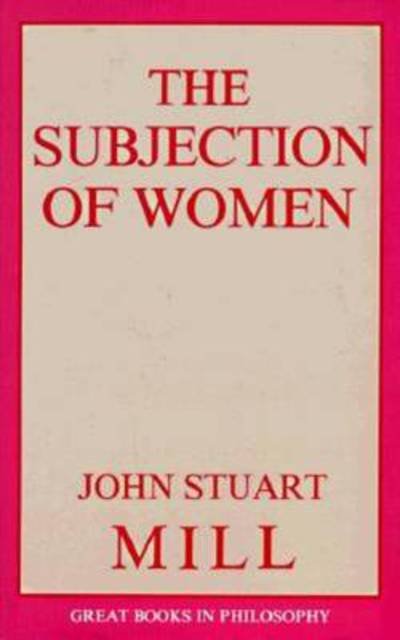
The Subjection of Women John Stuart Mill
Ordered from remote warehouse
Our customers say:


Also available as:
- Paperback Book (2015) $ 13.49
- Paperback Book (2016) $ 13.99
- Paperback Book (2014) $ 13.99
- Paperback Book (2016) $ 13.99
- Paperback Book (2014) $ 14.49
- Paperback Book (2015) $ 14.99
- Paperback Book (2018) $ 14.99
- Paperback Book (2023) $ 15.49
- Paperback Book (2019) $ 15.49
- Paperback Book (2016) $ 15.49
- Paperback Book (2013) $ 15.99
- Paperback Book (2017) $ 15.99
- Paperback Book (2017) $ 15.99
- Paperback Book (2017) $ 15.99
- Paperback Book (2018) $ 16.49
- Paperback Book (2016) $ 16.49
- Paperback Book (2016) $ 16.99
- Paperback Book (2017) $ 16.99
- Paperback Book (2016) $ 17.49
- Paperback Book (2011) $ 17.49
- Paperback Book (2013) $ 17.49
- Paperback Book (2013) $ 19.99
- Paperback Book (2008) $ 20.99
- Paperback Book (2016) $ 21.99
- Paperback Book (2020) $ 22.99
The Subjection of Women
John Stuart Mill
"The Subjection of Women" (1869) offers both detailed argumentation and passionate eloquence in opposition to the social and legal inequalities commonly imposed upon women by a patriarchal culture. Just as in "On Liberty," Mill defends the emancipation of women on utilitarian grounds. Mill was convinced that the moral and intellectual advancement of humankind would result in greater happiness for everybody. He asserted that the higher pleasures of the intellect yielded far greater happiness than the lower pleasure of the senses. He conceived of human beings as morally and intellectually capable of being educated and civilized. Mill believed everyone should have the right to vote, with the only exceptions being barbarians (referring to savages) and uneducated people. Mill argues that people should be able to vote to defend their own rights and to learn to stand on their two feet, morally and intellectually. This argument is applied to both men and women. Mill often used his position as a member of Parliament to demand the vote for women, a controversial position for the time. In Mill's time a woman was generally subject to the whims of her husband and/or father due to social norms which said women were both physically and mentally less able than men, and therefore needed to be "taken care of." Contributing to this view were social theories, i.e. survival of the fittest and biological determinism, based on a now considered incorrect understanding of the biological theory of evolution and also religious views supporting a hierarchical view of men and women within the family. The archetype of the ideal woman as mother, wife and homemaker was a powerful idea in 19th century society. At the time of writing, Mill recognized that he was going against the common views of society and was aware that he would be forced to back up his claims persistently. Mill argued that the inequality of women was a relic from the past, when "might was right,"but it had no place in the modern world. Mill saw that having effectively half the human race unable to contribute to society outside of the home as a hindrance to human development.
| Media | Books Paperback Book (Book with soft cover and glued back) |
| Released | January 21, 2012 |
| ISBN13 | 9781469945811 |
| Publishers | CreateSpace Independent Publishing Platf |
| Pages | 132 |
| Dimensions | 152 × 229 × 7 mm · 185 g |
| Language | English |
More by John Stuart Mill
Show all







![Cover for John Stuart Mill · Essais Sur La Religion, (Ed.1875) (French Edition) (Paperback Book) [French edition] (2022)](https://imusic.b-cdn.net/images/item/original/448/9782012661448.jpg?john-stuart-mill-2022-essais-sur-la-religion-ed-1875-french-edition-paperback-book&class=scaled&v=1409647394)
![Cover for John Stuart Mill · Le Gouvernement Representatif (3e Ed.) (Ed.1877) (French Edition) (Paperback Book) [French edition] (2022)](https://imusic.b-cdn.net/images/item/original/847/9782012686847.jpg?john-stuart-mill-2022-le-gouvernement-representatif-3e-ed-ed-1877-french-edition-paperback-book&class=scaled&v=1410237929)


More from this series


See all of John Stuart Mill ( e.g. Paperback Book , Hardcover Book , Book , CD and Audiobook (CD) )