
Tell your friends about this item:
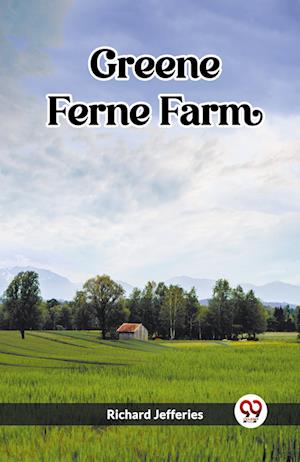
Greene Ferne Farm Richard Jefferies


Greene Ferne Farm
Richard Jefferies
Publisher Marketing: "Up to Church." "Fine growing marning, you." "Ay, casualty weather, though." Ding-ding-dill! Dill-ding-dill! This last was the cracked bell of the village church ringing "to service." The speakers were two farmers, who, after exchanging greeting, leant against the churchyard wall, and looked over, as they had done every fine-weather Sunday this thirty years. So regular was this pressure, that the moss which covered the coping-stones elsewhere was absent from the spot where they placed their arms. On the other side of the wall, and on somewhat lower ground, was a pigsty, beyond that a cow-yard, then a barn and some ricks. "Casualty," used in connection with weather, means uncertain. Mr Hedges, the taller of the two men, stooped a good deal; he wore a suit of black, topped, however, by a billycock. Mr Ruck, very big and burly, was shaped something like one of his own mangolds turned upside-down: that is to say, as the glance ran over his figure, beginning at the head, it had to take in a swelling outline as it proceeded lower. He was clad in a snowy-white smock-frock, breeches and gaiters, and glossy beaver hat. This costume had a hieroglyphic meaning. The showy smock-frock intimated that he had risen from lowly estate, and was proud of the fact. The breeches and gaiters gave him an air of respectable antiquity in itself equivalent to a certain standing. Finally the beaver hat-which everybody in the parish knew cost a guinea, and nothing less-bespoke the thousand pounds at the bank to which he so frequently alluded. Contributor Bio: Jefferies, Richard John Richard Jefferies (6 November 1848 - 14 August 1887) was an English nature writer, noted for his depiction of English rural life in essays, books of natural history, and novels. His childhood on a small Wiltshire farm had a great influence on him and provides the background to all his major works of fiction. For all that, these show a remarkable diversity, including Bevis (1882), a classic children's book, and After London (1885), an early work of science fiction. For much of his adult life, he suffered from tuberculosis, and his struggles with the illness and with poverty also play a role in his writing. Jefferies valued and cultivated an intensity of feeling in his experience of the world around him, a cultivation that he describes in detail in The Story of My Heart (1883). This work, an introspective depiction of his thoughts and feelings on the world, gained him the reputation of a nature mystic at the time. But it is his success in conveying his awareness of nature and people within it, both in his fiction and in essay collections such as The Amateur Poacher (1879) and Round About a Great Estate (1880), that has drawn most admirers. Walter Besant wrote of his reaction on first reading Jefferies: "Why, we must have been blind all our lives; here were the most wonderful things possible going on under our very noses, but we saw them not."
| Media | Books Paperback Book (Book with soft cover and glued back) |
| Released | August 19, 2014 |
| ISBN13 | 9781500813024 |
| Publishers | Createspace |
| Pages | 78 |
| Dimensions | 152 × 229 × 4 mm · 117 g |
More by Richard Jefferies
Show all















![Cover for Richard Jefferies · After London: or Wild England (Easy to Read Layout) (Paperback Book) [Large type / large print edition] (2021)](https://imusic.b-cdn.net/images/item/original/204/9791029913204.jpg?richard-jefferies-2021-after-london-or-wild-england-easy-to-read-layout-paperback-book&class=scaled&v=1642613338)





More from this series

See all of Richard Jefferies ( e.g. Paperback Book , Hardcover Book , Book , Bound Book and Book pack )